Sunday, March 7, 2021

Racial themes of good and evil (Part IV)

The following story is taken directly from the OCA article on Saint Niphon, Bishop of Cyprus. I have only decided to archive it here as well, as it mentions the black face "like that of an Ethiopian", a rather common trope.

"Saint Niphon, Bishop of Cyprus was born in Paphlagonia, and was educated at Constantinople. In childhood he was gentle and good, and he often attended church services, but in his youth he began to lead a prodigal and sinful life. He sometimes came to his senses, and he was horrified by the extent of his fall; but believing that he was lost and could not receive forgiveness, he resumed his impious life.

He once met a friend who gazed into his face for a long time with astonishment. When Niphon asked why he was staring, the friend replied, “I have never seen your face like this before. It is black, like that of an Ethiopian.” These words showed to Niphon his fallen state, and he began to cry out to the Mother of God, begging Her intercession.

After an intense and long prayer he saw that the face of the Mother of God on the holy icon was radiantly bright with a smile. From that time Niphon prayed incessantly to the Queen of Heaven. If he fell into sin, the face of the Mother of God turned away from him, but after tears and prayers, She mercifully turned toward him again.

Finally, Niphon completely turned his life around and began to spend his time in prayer and repentance. After an illness, from which he received healing from the Mother of God, he received the Holy Mysteries, and then accepted monastic tonsure and intensified his efforts, exhausting his body in the struggle against the passions.

This struggle lasted for many years, and devils often attacked Saint Niphon, but with the help of God he overcame them. He received from God the gift to discern evil spirits and defeat them, and also to see the departure of the soul after death. Already advanced in age, and arriving at Alexandria, he was pointed out to the Patriarch in a vision as one worthy to assume the office of bishop. They made him bishop of the city of Constantia on the island of Cyprus. However, he did not remain there for long. Saint Niphon knew the time of his death three days beforehand. Saint Athanasius the Great visited him before his blessed repose. On his deathbed the saint was granted to see angels and the All-Pure Mother of God."

Friday, January 22, 2021

The Last Holy Liturgy in Byzantine Constantinople

I wish to share a mystical story related by Steven Runciman in from his book "Fall of Constantinople" (page 147). It speaks of events from inside the Hagia Sophia during the final day in 1453, and gives divine hope with spiritual quality. 

"Then the [Turkish] sailors from both fleets and the first batches of soldiers from the land-walls converged on the greatest church of all Byzantium, the Cathedral of the Holy Wisdom. 

The church was still thronged. The Holy Liturgy was ended, and the service of matins was being sung. At the sound of the tumult outside the huge bronze gates of the building were closed. Inside the congregation prayed for the miracle that alone could save them. They prayed in vain. It was not long before the doors were battered down. The worshippers were trapped. A few of the ancient and infirm were killed on the spot; but most of them were tied of chained together. Veils and scarves were torn off the women to serve as ropes. Many of the lovelier maidens and youths and many of the richer-clad were almost torn to death as their captors quarreled over them. Soon a long procession of ill-assorted little groups of men and women bound rightly together was being dragged to the soldiers' bivouacs, there to be fought over once again. The priests went on chanting at the altar till they too were taken. But at the last moment, so the faithful believed, a few of them snatched up the holiest vessels and moved to the southern wall of the sanctuary. It opened for them and closed behind them; and there they will remain until the sacred edifice becomes a church once more." 

A truly marvelous story!

As his source for this story Runciman cited the Byzantine historians George Sphrantzes and Michael Critobulus, as well as the Latin cleric Leonard of Chios. Unfortunately, I have not been able to track this story down through resources online, however Runciman was a famous Byzantinologist, and thus certainly found access to the sources he cited. 

Monday, November 16, 2020

St. Hippolytus of Rome's Commentary on Genesis 8

This is St. Hippolytus of Rome's commentary on Genesis 8 taken from Catena. I post it on here because a thread on Twitter would have been too impractical but I still wanted to have this commentary saved.

"Hippolytus, the expositor of the Targum, and my master, Jacobus Rohaviensis, have said: On the twenty-seventh day of the month Jiar, which is the second Hebrew month, the ark rose from the base of the holy mount; and already the waters bore it, and it was carried upon them round about towards the four cardinal points of the world. The ark accordingly held off from the holy mount towards the east, then returned towards the west, then turned to the south, and finally, bearing off eastwards, neared Mount Kardu on the first day of the tenth month. And that is the second month Kanun. And Noah came out of the ark on the twenty-seventh day of the month Jiar, in the second year: for the ark continued sailing live whole months, and moved to and fro upon the waters, and in a period of fifty-one days neared the land. Nor thereafter did it float about any longer. But it only moved successively toward the four cardinal points of the earth, and again finally stood toward the east. We say, moreover, that that was a sign of the cross. And the ark was a symbol of the Christ who was expected. For that ark was the means of the salvation of Noah and his sons, and also of the cattle, the wild beasts, and the birds. And Christ, too, when He suffered on the cross, delivered us from accusations and sins, and washed us in His own blood most pure. And just as the ark returned to the east, and neared Mount Kardu, so also Christ, when the work was accomplished and finished which He had proposed to Himself, returned to heaven to the bosom of His Father, and sat down upon the throne of His glory at the Father's right hand. As to Mount Kardu, it is in the east, in the land of the sons of Raban, and the Orientals call it Mount Godash; the Arabians and Persians call it Ararat. And there is a town of the name Kardu, and that hill is called after it, which is indeed very lofty and inaccessible, whose summit no one has ever been able to reach, on account of the violence of the winds and the storms which always prevail there. And if any one attempts to ascend it, there are demons that rush upon him, and cast him down headlong from the ridge of the mountain into the plain, so that he dies. No one, moreover, knows what there is on the top of the mountain, except that certain relics of the wood of the ark still lie there on the surface of the top of the mountain."

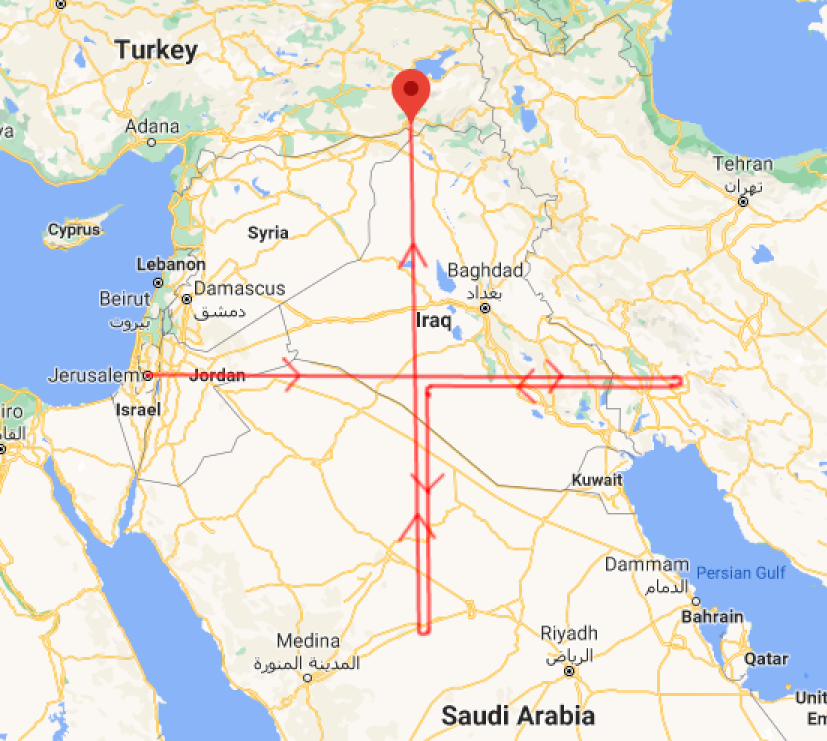
From my understanding the voyage would have looked something as shown in the image below. The starting point I took as the Temple Mount (Holy Mount), and the destination to be Mount Kardu as mentioned in the commentary (also known as Mount Judi or Mount Cudi)


Tuesday, October 6, 2020

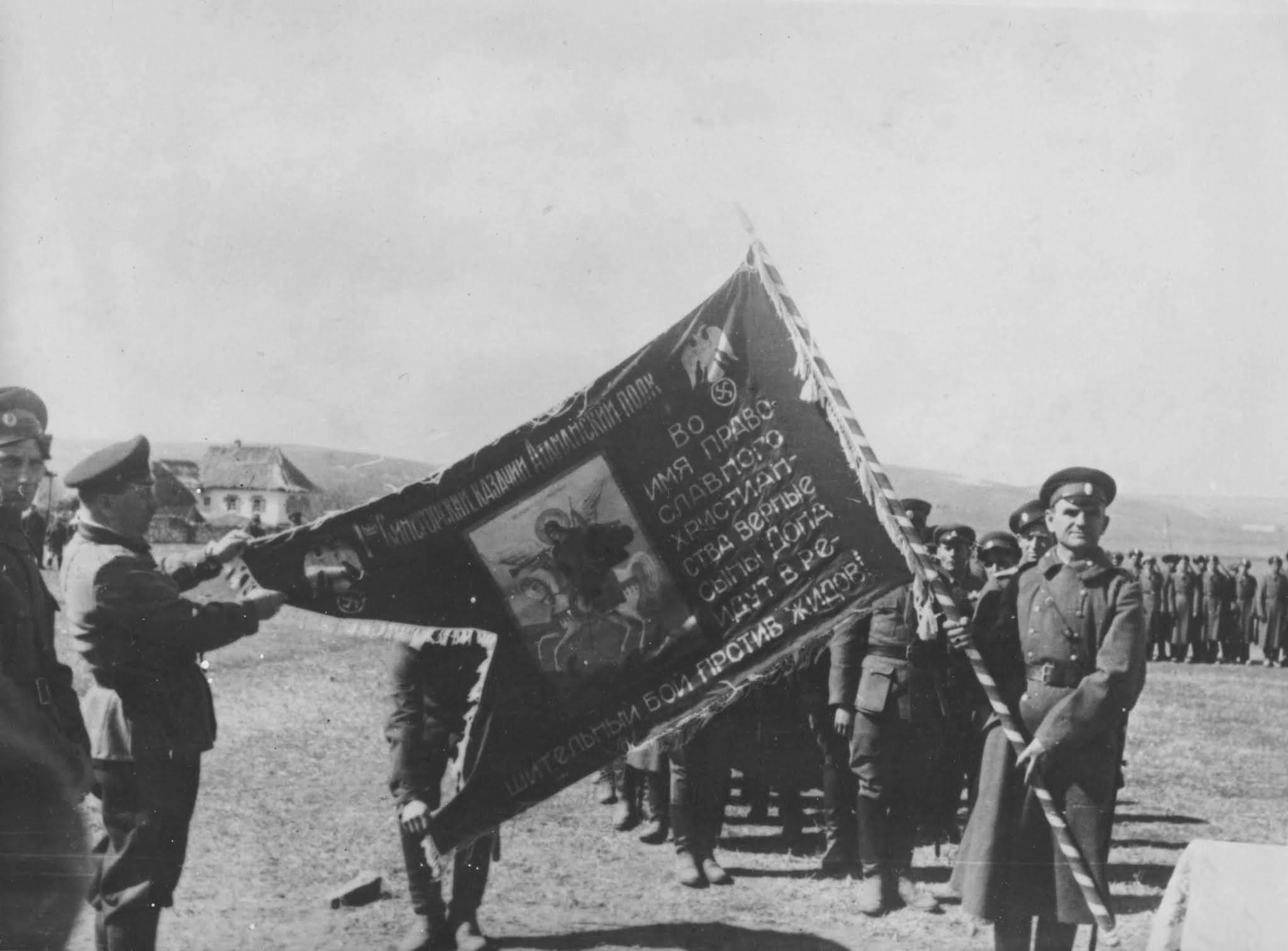
XV SS Cossack Cavalry Corps: 1st Cossack Cavalry Division


Cossacks of Helmuth von Pannwitz. The flag depicts St. Archangel Michael killing Satan, with the text: 

"In the name of Orthodox Christianity, the faithful sons of Don are going into a decisive battle against the Jews!"


Monday, October 5, 2020

Racial themes of good and evil (Part III)

This post is the third article in the series of "racial themes of good and evil" which I have written on my blog so far. I highly recommend going back and reading parts I and II which give an explanation of the thesis of this series and various examples from the early church fathers and martyrs. 

In this article the example which will be shown is from the modern times. Namely from St. Nikolai Velimirovich's book "War and the Bible", originally published in 1931, which mentions race in a Christian context. 

In St. Nikolai's book the reference to the White race is made explicit. The book starts out with an ominous warning:

"From the Holy Revelation of God it is clear to whom God will grant victory. This is clear from the example of all wars in the history of mankind, if they are considered in the coverage of Holy Revelation. The will of God gives victory to the one who has the clearest and strongest faith in God and who fulfills His law [...] If not a single Christian people repent and return to Christ, the center of their soul and life, then God will give the victory to the non-Christian, Asian peoples."

Are we not seeing this today to some extent? With the Chinese economy set to overtake the United States and the Chinese (economically) taking over African countries (the old European colonies) this is seemingly already taking place. 

He explicitly makes the connection between White and Christian in his chapter "Weapons":

"These are the peoples of the white race, the peoples called 'Christian'."

St. Nikolai further writes: 

"God breathed into man the striving for culture so that through it the human soul would manifest its dominance over the world of matter and its devotion and service to God. Thus, all these values ​​would take on an angelic image through the service and love that the Lord Jesus Christ commanded . But, just as the Seraphim, who once fell away from God, who was called Lucifer, became the devil, so these values ​​became idols, demons without God.

Note that relative satiety with these idols leads people to laziness, corruption, decay, disgust for everything, dementia and suicide (as, for example, at the end of the Roman Empire); and dissatisfaction leads to extreme grief, envy, grumbling, shamelessness, all kinds of violence and, in the end, again to suicide. In both cases, these idols breathe hatred and contempt for the Meek and Good Lord Christ and, therefore, lead to war...

You will have noticed, of course, that I am only talking about Christian peoples. I'm not doing this without reason, General. After all, it was they who fought the last World War, and they are preparing a new one. During the last 150 years, since the fight against God arose in Europe, the European peoples have fought incomparably more than the rest of the world. War was the scourge of God to make the unreasonable [reasonable]. But the unreasonable did not come to their senses. They fall deeper and deeper, fly into the abyss... Those who were chosen by God to be "salt and light" have lost their strength and faded. Although they boast that they are the salt of the earth and the light of the world, no one believes them anymore. Neither India, nor China, nor Africa anymore look at white people as salt and light of the earth, considering them insignificance and darkness. From all that has been said, it is clear that:

1) the reasons for the future war lie in the apostasy from God and the idolatry of Christian nations and their leaders;

2) these reasons are identical with the reasons for the wars from which Israel suffered and perished, which was once the salt and light of the world;

3) these reasons must be quickly destroyed by repentance and a return to God, because otherwise a whole series of future wars will undoubtedly lead to the death of Christian nations, but not Christianity itself ."

He repeats himself later in the book, reiterating:

"If God neither in Europe nor in America finds a single worthy people of the white race, then in case of war He will grant victory to one of the Asian nations..."

Further, ominous punishments are mentioned by the Saint: 

Punishing "the theomachist people who have fallen away from God, the Lord sometimes sends them to distant peoples. Thus, the Israelites were brought from Egypt to be punished by the Canaanite pagans. As punishment for the Europeans, Attila and Genghis Khan were sent from distant Asia; to punish the Spaniards, the Saracens, and the Balkans, the Turks."

St. Nikolai concludes his book and writes a passage on the spiritual staet of our race and I believe it to be truly beautiful and emotional to read: 

"The white race can change their spirit, correct their thoughts, tame their aspirations, for things that have no real value, and go to a good goal, for the One Who said: "I am the Way." Maybe if she wants to. But would she? From falling into the abyss to being rescued from it and safe is one step. Will people want to retreat just one step from the terrible abyss they are standing over? God is waiting for an answer to this question; waiting like a father, loving and caring. At least every day they gave God a negative answer - by His mercy and love, God waits; waiting to hear a kind answer from any people to deflect the disaster."

My brothers, it is clear: the only way forward for the White race is with Christ. If we have any hopes of changing our collective situation we should begin with changing ourselves first. We must return to Christ and His original Church: the Orthodox Church.
Sunday, August 2, 2020

Racial themes of good and evil (Part II)

As a continuation to the last post on racial themes in Christianity I have compiled various examples from scripture and tradition to demonstrate the existence of racism in our Tradition. I recommend to read the first article, as it introduces this topic. 

The first story is of St. Christopher the Great Martyr. As he was being martyred for his faith he received a vision. "The blessed one [St. Christopher] would say, that he saw a tall and large-bodied man, fair in countenance, who wore white garments, and with the lightning bolts flashing from his countenance, he covered the brilliance of the sun. On his head was a bright crown, and around him were soldiers with a fiery form, against whom fought others who were black and ugly, and they appeared to be victorious. But when that awesome ruler turned with anger, he frightened and trampled all those who battled against him, and he received from them authority and power." Perhaps this vision relates to Archangel Michael and Lucifer warring in Heaven, nevertheless, the symbolism is clear.

Next is the very obscure writing of St. Ambrose "Noe et Arca", which is about Noah's ark. I have only managed to find this in Latin, with it not being discussed at all in the English language. In book 1, chapter 34, paragraph 128 St. Ambrose writes the following:

"Color Aethiopis tenebras animae squaloremque significat, qui adversus lumini est, claritatis exsors, tenebris involutus, nocti similior quam diei."

This translates to:
"The colour of the Ethiopians signifies darkness and the squalor of their soul, which is opposed to light, excluded from clarity, is wrapped in darkness which is more similar to night than day"

Moving further, also on the same topic of 'Ethiopians', another Church father, Pope St. Peter I of Alexandria comments in his Canonical Epistle, in canon 4 on Jeremiah 13:23. He speaks of the "reprobate, and unrepentant, who possess the Ethiopian's unchanging skin". The 12th century Byzantine chronicler and canonist, John Zonaras comments on this canon adding that this type of people "carry about with them perpetually the inherent and indelible blackness of sin, as of an Ethiopian's skin, or the leopard's spots." 

To speak further on racial themes, St. Paul in his Epistle to Titus 1:12 "One of them, a prophet of their own, said, “Cretans are always liars, evil beasts, lazy gluttons." Is St. Paul racist against Cretans? Maybe not since both St. Paul and the Cretans are White...

Friday, July 10, 2020

Hebrew-Greek Shared Lineage

To start off, I want to share a Biblical passage from the Old Testament. 

“King Arius of the Spartans to Onias the high priest, greetings. It has been put in writing regarding both the Spartans and the Jews that they are brothers, and are both of the family of Abraham" - 1 Maccabees 12:20-22


And here is a nice aesthetic image to go along with this 

This letter is also mentioned in Josephus' "Antiquities" 12.4.10

However, it is not only this one instance that shows the connection between the two peoples. As it is found in Diodorus Siculus' "Library of Histories" 40.3. There one can see that not all Israelites (or Hebrews if that term might be more fitting) went to the Holy Land with Moses, but some went to Greece. 

"All the foreigners [Israelites] were forthwith expelled, and the most valiant and noble among them, under some notable leaders, were brought to Greece and other places, as some relate; the most famous of their leaders were Danaus and Cadmus."


Danaus, founder of Argos 


Cadmus, founder of Thebes


I believe this is important historical information, in an age where many very comfortably accept the lie that the Jews of today are God's chosen people. The rabbit hole of European history goes very deep, and God's providence can be witnessed playing out.